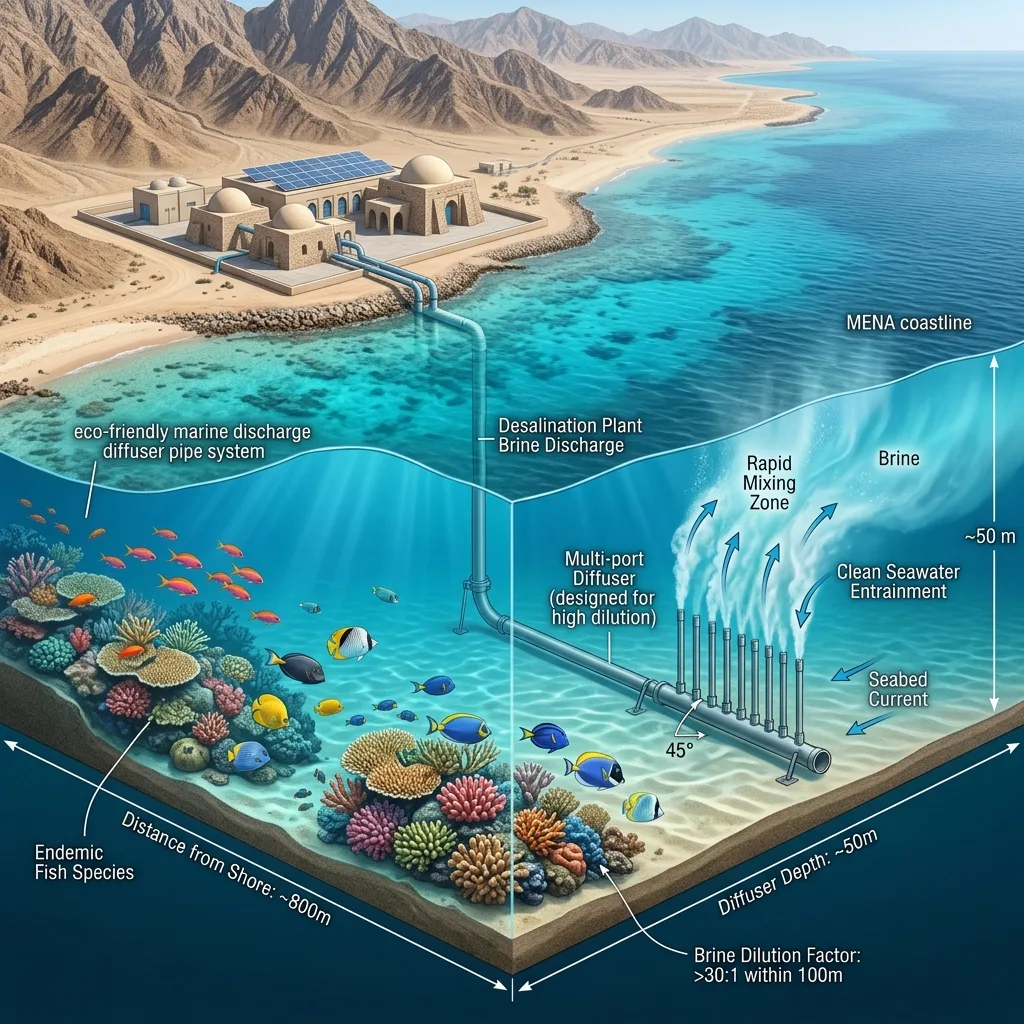
Brine (saline wastewater) management is one of the most discussed topics in desalination debates. A SWRO plant produces about 1.5-2 m³ of brine for every 1 m³ of fresh water. This brine contains about twice as much salt as normal seawater. Is discharging this brine back into the sea an environmental hazard, or a process that can be managed with proper engineering? With proper engineering, this process can be managed safely without harming the environment.
1. Environmental Impacts and Risks of Brine
The environmental impacts of brine discharge manifest mainly in three areas: high salt concentration (hypersalinity) at the discharge point, temperature increases (mostly in thermal plants), and chemical residues from antiscalants or biocides used in the plant. Proper engineering practices are essential to ensure these impacts do not harm local marine benthic ecosystems.
2. Dilution and Dispersion Methods
The most effective solution is to rapidly dilute the brine before or during discharge. For this purpose, multi-port diffuser systems are used to spread the discharge over a wide area via nozzles. Additionally, active pre-dilution with seawater or choosing discharge depths with strong natural currents helps salt concentrations return to ambient levels very quickly.
3. Measures in Sensitive Areas Like Coral Reefs
In regions hosting unique coral reefs like the Red Sea and Arabian Gulf, brine dilution systems must be designed with higher precision. At DipBlue, we perform advanced hydrodynamic current simulations for these projects, positioning discharge points far from coral colonies, in corridors with the strongest currents.
4. Regulations and Environmental Limits
Environmental permit processes in MENA countries are adopting increasingly strict standards. Limits on desalination brine typically cover continuously monitored salinity difference (ΔTDS), temperature difference (ΔT), turbidity, and active chlorine residues. Online discharge monitoring systems are utilized to prevent exceedances.
| Parameter | Typical Limit | Monitoring Frequency |
|---|---|---|
| Salinity difference (ΔTDS) | < 5 ppt (from ambient) | Continuous / every 4 hours |
| Temperature difference (ΔT) | < 3°C | Continuous |
| Turbidity | < 10 NTU | Daily |
| Chlorine (residual) | < 0.1 mg/L | Continuous |
5. Is Zero Liquid Discharge (ZLD) Realistic?
The answer to whether zero liquid discharge (ZLD) is realistic in desalination depends on economic and practical limits. ZLD systems require evaporating wastewater completely to obtain solid salt. This process consumes many times more energy compared to normal reverse osmosis. Therefore, ZLD is not currently an economic alternative for large-scale drinking water projects.
Conclusion: Sustainable Desalination with Proper Engineering
Brine wastewater is a reality of desalination that must be managed. Thanks to properly planned diffuser designs and environmental current modeling, it is possible to produce water at high capacities with zero harm to the environment.