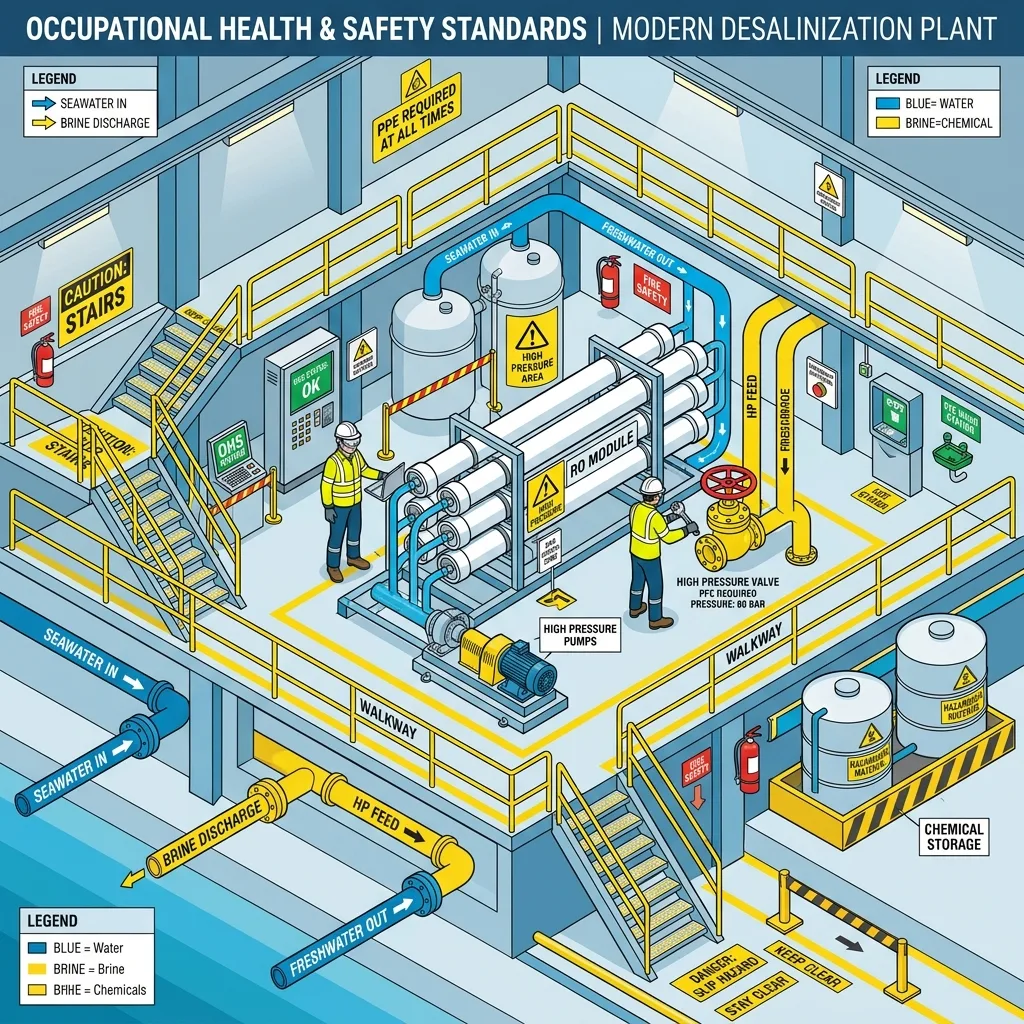
A desalination plant appears to be a calm place. Pumps hum, water flows in pipes, and numbers flash on screens. Under this calm, however, lie serious hazards: pipes under 60-70 bar pressure, strong acids and bases, high-voltage equipment, and oxygen-depleted confined spaces. At DipBlue, we view occupational health and safety (OHS) not as paperwork, but as an engineering discipline.
1. High Pressure Hazard: Deadly Leaks
High-pressure pumps and pipes (60-70 bar) operate in SWRO plants. At this pressure, a leak turns water into a jet powerful enough to cut metal. A burst hose or fitting can cause severe injuries. High-pressure safety procedures in reverse osmosis plants cover pressure testing, protective barriers, remote-controlled valves, pressure relief valves (PRV), and Lock-out Tag-out (LOTO) systems.
2. Chemical Safety: Acids, Bases, and Antiscalants
A SWRO plant uses numerous chemicals. Exposure to chemicals like sulfuric acid (H₂SO₄), sodium hypochlorite (NaOCl), and antiscalants carries serious risks. Our chemical safety and personal protective equipment (PPE) standards in SWRO plants cover chemical-resistant aprons, coveralls, nitril gloves, eye wash stations, safety showers, and double-walled containment basins.
| Chemical | Hazard Class | Exposure Risk |
|---|---|---|
| Sülfürik asit (H₂SO₄) | Corrosive | Skin burns, respiratory damage |
| Sodyum hipoklorit (NaOCl) | Oxidizer | Chlorine gas, eye and respiratory damage |
| Sodyum bisülfit (NaHSO₃) | Irritant | Allergic reaction, asthma |
| Antiskalant (polimer) | Low toxicity | Eye contact irritation |
3. Confined Space Works: The Silent Danger
Membrane pressure vessels, clean water tanks, and sand filters are categorized as confined spaces in desalination plants. The most common risk in these areas is oxygen deficiency and toxic gas accumulation. Desalination plant confined space work risks and permit systems require written entry permits, continuous atmospheric testing (O₂, H₂S), entry standby watchmen, and portable ventilation or breathing apparatus.
4. Operator Health and Ergonomics
Operator health risks in seawater desalination plants also include chronic effects. Standard practices include ear protection against pump noise, mechanical lifters against muscle-skeletal disorders during heavy membrane replacements, and smart rotation protocols against shift-system fatigue.
Conclusion: Zero Accident Goal is a Culture
Occupational safety in desalination is as important as water production quality. A zero-accident policy is the core component of long-term safe operations.