“The water crisis is coming” is a common rhetoric. But it is often misframed. The problem is not the lack of water, but how it is managed. Today, many regions experience crises despite having sufficient total water potential. This is not a resource problem—it’s a planning problem.
1. Where Does the Crisis Start? In the System, Not the Source
The water cycle still works: it rains, rivers flow, oceans are full. But if these resources are not properly collected, efficiently distributed, and strategically supported, the system breaks. Result: local shortages turn into regional crises.
2. The Traditional Approach: Single Source Dependency
Many water infrastructures still rely on a single source (only dams, only groundwater, or only rivers). The problem with this approach is high risk and low flexibility. When a drought hits, the dam is empty; with overuse, groundwater runs out. Single-source systems are unsustainable in a changing world.
3. Engineering Reality: Water Can Be Produced
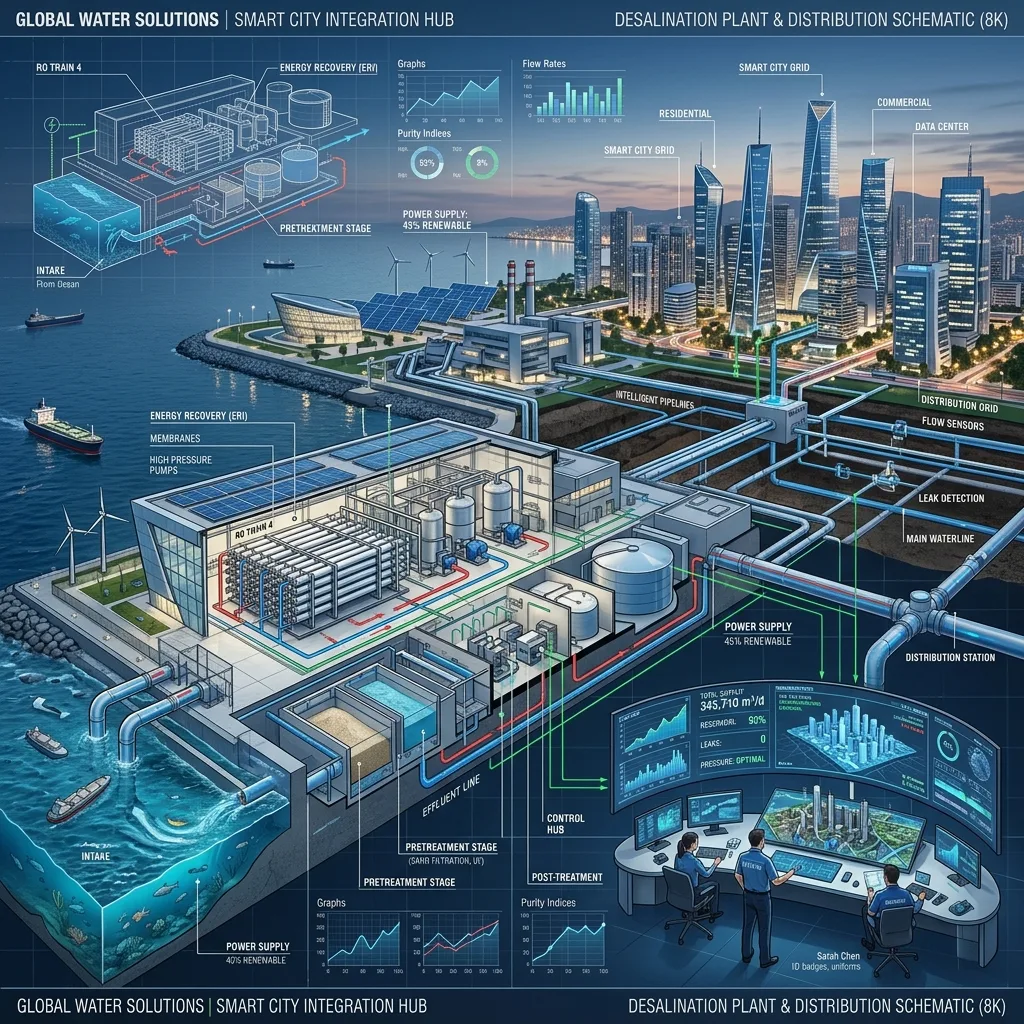
The fundamental principle of modern water management is: Water is not just a collected resource—it is a produced one. With desalination, source dependency decreases, production is brought under control, and the system stabilizes. The question ‘Is there enough water?’ now turns into ‘Is there enough production capacity?’
4. The Right Model: Hybrid Water Infrastructure
The most robust water systems are not dependent on a single source. The optimal model is a hybrid structure combining surface water (dams), groundwater, and desalination. This triad spreads risk, ensures continuity, and prevents crises. Desalination here is not an ‘alternative’, but the main stabilizing component.
5. The True Cost of Planning Failures
Water crises are not just technical issues, they have heavy economic consequences: production losses, agricultural yield drops, tourism revenue declines, and social costs. These losses are often the result of wrong infrastructure investments. The true cost is not investing, or investing wrongly.
6. Climate Change: Making Planning Mandatory
Climate change increases uncertainty; rainfall becomes erratic, droughts lengthen, and resources become unpredictable. The old approach no longer works; the new approach must be flexible, scalable, and multi-sourced. Desalination is the most critical part of this structure because it is climate-independent.
7. The Future: Water Management = Infrastructure Management
In the future, successful cities and countries will not be those with the most water, but those that manage it best. Proper capacity planning, correct technology investments, and right system integration are mandatory. Water is no longer just a matter of nature, but an engineering and management issue.
Conclusion: Defining the Problem Correctly Wins
The phrase ‘water crisis’ is incomplete; the correct term is ‘planning crisis’. Because water can be produced, systems can be optimized, and risks can be managed. With the right infrastructure, water scarcity is not an inevitable disaster, but a solvable engineering problem.