Introduction
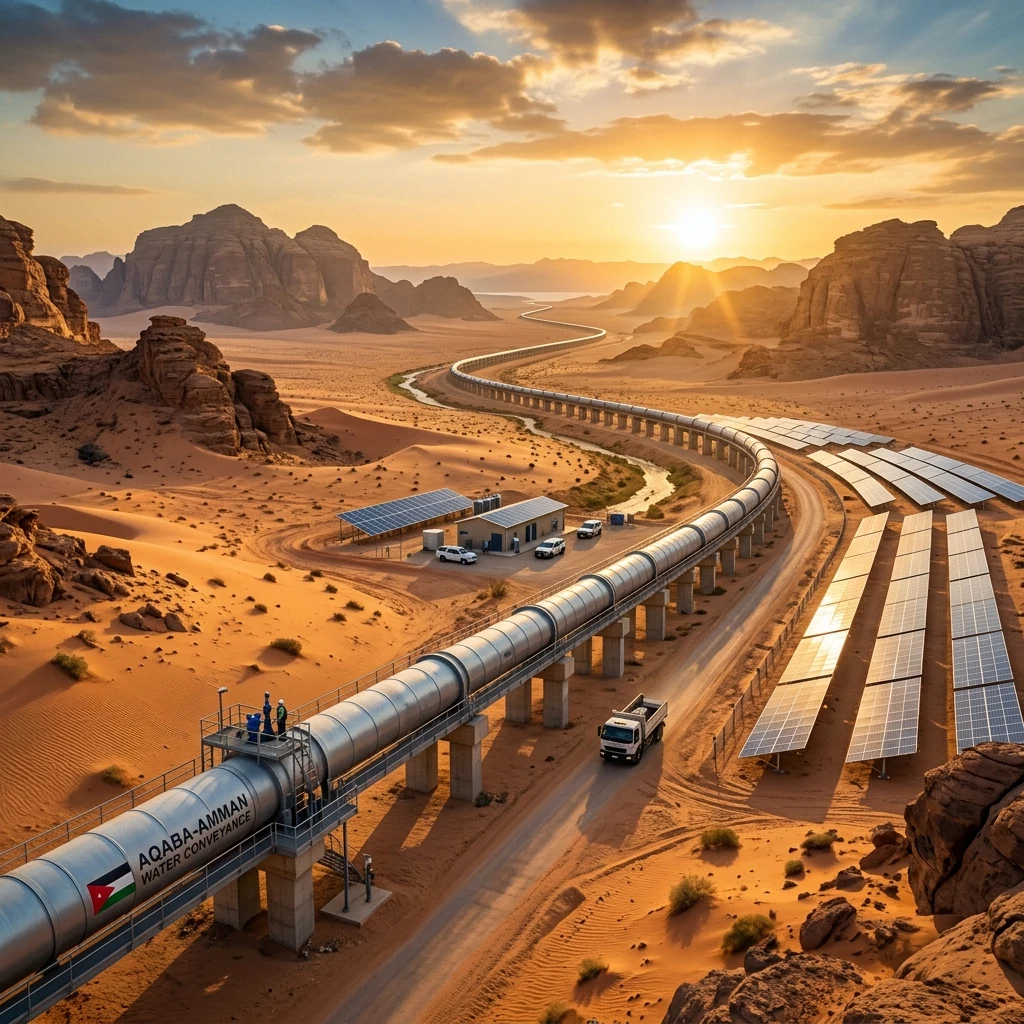
Jordan is undertaking one of the most ambitious water infrastructure projects in modern history. The Aqaba-Amman Water Desalination and Conveyance Project—also known as the National Water Carrier—represents a $5.8 billion commitment to securing the Kingdom’s water future. This landmark project offers critical lessons for water-scarce nations worldwide.
The Scale of Ambition
The numbers are staggering:
- Annual production: 300 million cubic meters of desalinated seawater
- Pipeline length: 438 kilometers of underground pipeline
- Elevation challenge: Pumping systems capable of lifting water to 1,100 meters above sea level
- Solar capacity: 300 MW solar power plant providing approximately 28-30% of the project’s electricity needs
- Water supply impact: Will provide approximately 40% of the Kingdom’s drinking water needs
The Water Crisis Context
Jordan represents the extreme end of global water scarcity. Annual renewable water resources are less than 61 m³ per capita, well below the 500 m³ absolute water scarcity threshold. Groundwater is being depleted twice as fast as it can be replenished, meeting only two-thirds of population demand. By 2025, water demand was expected to exceed available resources by 26%.
The crisis has been exacerbated by:
- Climate change impacts
- Refugee influx from regional conflicts
- Diminishing conventional water supplies
- Rapid population growth
Project Impact
Upon completion in 2030, the project will:
- Increase Jordan’s water supply by 40%
- Double annual per capita water share from 60 to 110 cubic meters
- Increase water supply frequency from one to three days per week across all governorates
- Alleviate pressure on traditional water sources
- Ensure water sufficiency until 2040
The Financial Architecture
The project’s financing structure represents a model for large-scale infrastructure:
- Total cost: $5.8 billion, with capital costs estimated at $4.3 billion
- Private sector financing: $2.9 billion from international institutions
- Government contribution: $722 million
- Grants: $663 million from the US, EU, Germany, Netherlands, UK, France, Italy, Japan, and the Green Climate Fund
- Local financing: $1.1 billion from Jordanian commercial banks led by the Housing Bank
Environmental Commitment
The project includes a 300 MW solar power plant sized to cap carbon emissions to 3.2 kg CO₂ per cubic meter of desalinated water produced. This renewable energy integration demonstrates the feasibility of reducing desalination’s carbon footprint even in large-scale projects.
Implications for the Region
Jordan’s mega-project offers lessons for other water-scarce nations:
- Large-scale desalination can significantly enhance water security
- International financing is available for well-structured projects
- Renewable energy integration is feasible
- Public-private partnerships can mobilize substantial capital
- Long-term planning is essential for water security
Conclusion
The Aqaba-Amman project represents a watershed moment for Jordan and the broader MENA region. It demonstrates that even the most water-scarce nations can achieve water security through commitment, international cooperation, and strategic investment.