Introduction
While reverse osmosis dominates today’s desalination landscape, emerging technologies promise to reshape the industry. Solar Electrochemical Distillation (SED) is among the most promising, offering the potential for highly efficient, sustainable desalination that could dramatically reduce costs and environmental impact.
Understanding SED
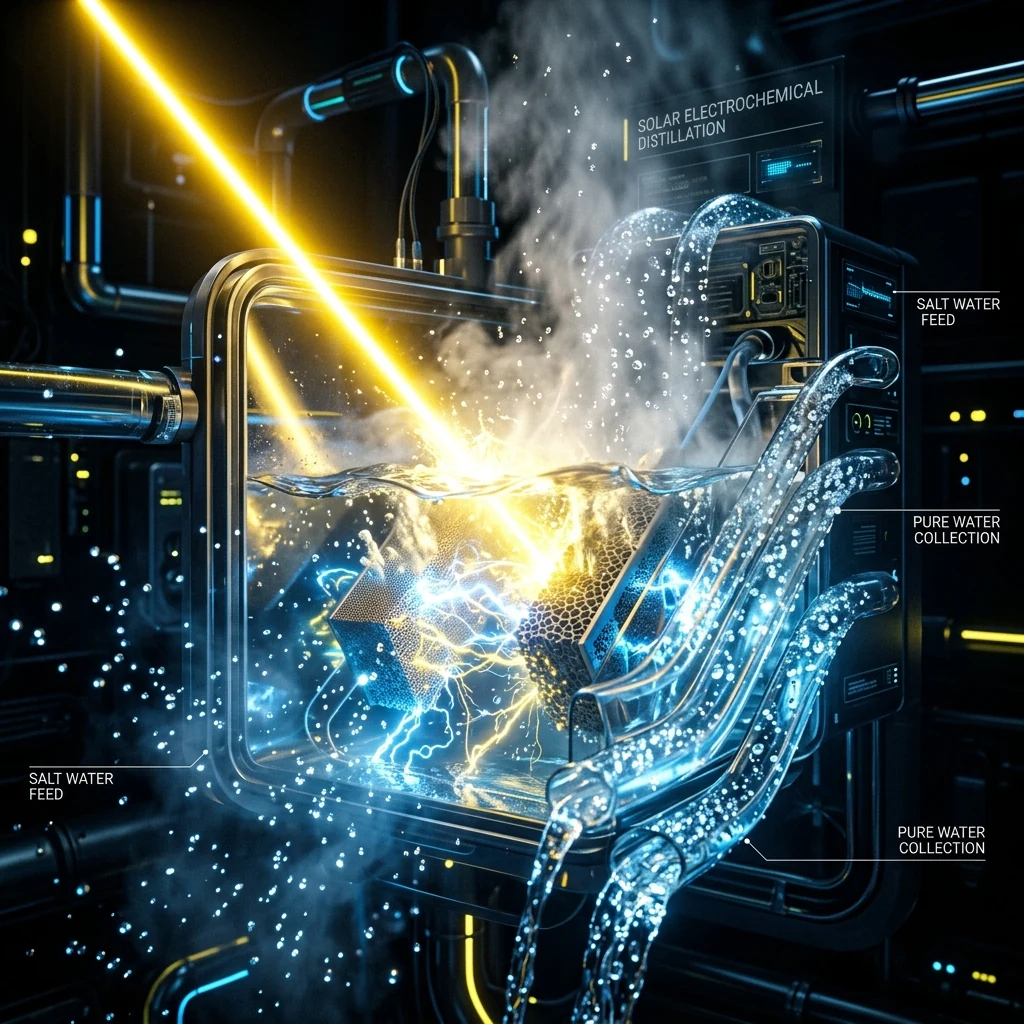
Solar Electrochemical Distillation combines solar energy with electrochemical processes to achieve desalination. Unlike conventional thermal or membrane approaches, SED leverages:
- Solar radiation as the primary energy source
- Electrochemical reactions for contaminant removal
- Potential for integration with energy storage
- Lower operating temperatures and pressures
Technology Components
An SED system typically integrates:
Solar Energy Collection
- Photovoltaic panels for electricity generation
- Thermal collectors for heat
- Concentrated solar power (CSP) for high-temperature processes
Electrochemical Processing
- Electrocoagulation for contaminant removal
- Electro-oxidation for organic pollutant destruction
- Capacitive deionization for salt removal
Distillation
- Low-temperature thermal distillation
- Membrane distillation
- Combined heat and power approaches
Performance Benchmarks
Recent developments in related solar desalination technologies demonstrate the potential:
- Solar-to-vapor conversion efficiencies exceeding 97%
- Evaporation rates of 1.4-2.2 kg/m²h for standard seawater
- Salt management in brines up to 25 wt% NaCl
- TDS below 10 mg/L, meeting WHO drinking water standards
- Stable operation beyond 15-28 days with salt-rejection systems
Advantages Over Conventional Technologies
SED offers several potential advantages:
Energy Efficiency
- Direct use of solar energy reduces conversion losses
- Electrochemical processes can be highly efficient
- Integration opportunities with energy storage
Environmental Sustainability
- Minimal greenhouse gas emissions
- Reduced chemical usage
- Potential for zero liquid discharge
Economic Viability
- Lower operating costs
- Reduced energy dependence
- Potential for modular, decentralized applications
Scalability
- Modular design possibilities
- Suitability for various scales
- Adaptability to different water qualities
Challenges and Research Directions
Research continues to address improving efficiency and scalability, reducing capital costs, extending operational lifetime, and optimizing system integration.
Conclusion
SED and related emerging technologies represent the next frontier in desalination. While still developing, these technologies offer the potential for more sustainable, cost-effective water production that could transform the industry in the coming decades.