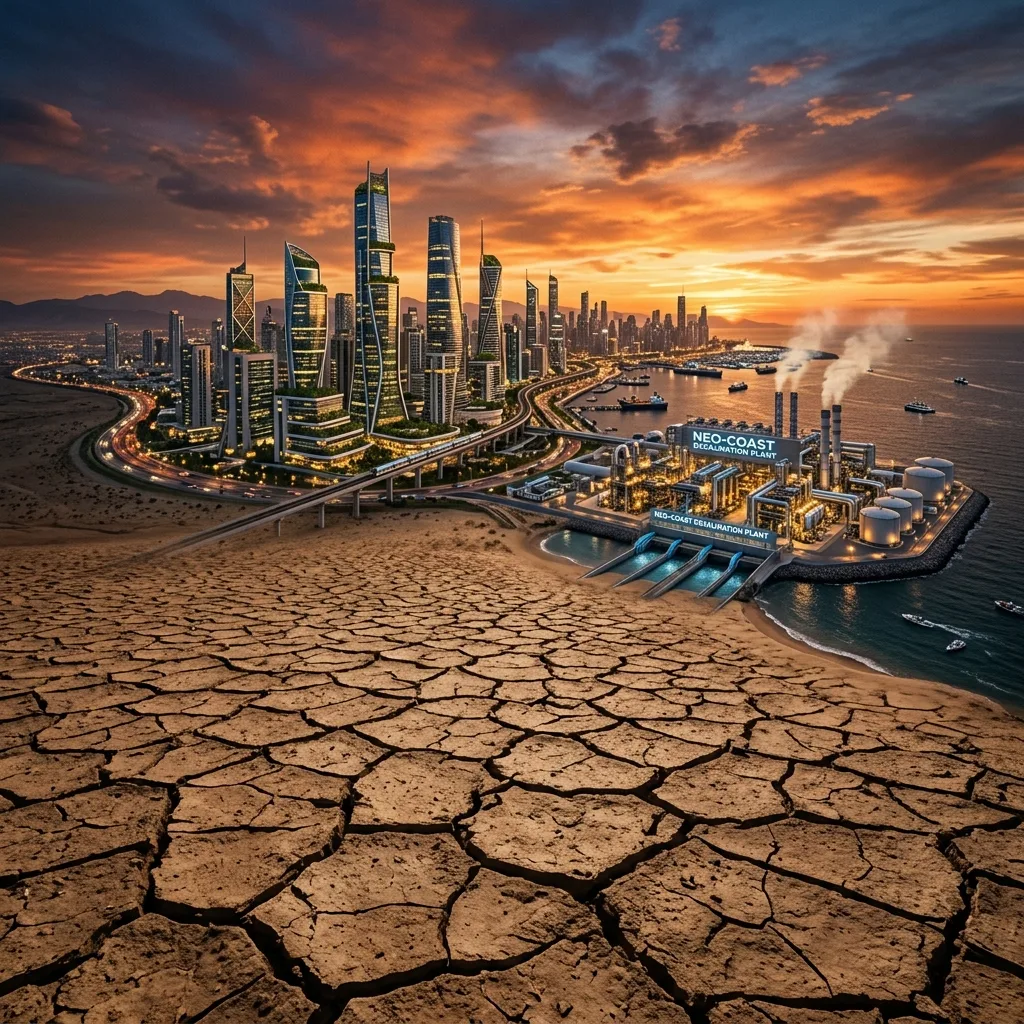
Drought is increasing; precipitation regimes are changing, and groundwater is being depleted. But the critical question is: if drought is increasing, is a water crisis really inevitable? The answer is no. Because the problem is not in the resource—it’s in the approach and infrastructure.
1. Drought is a Natural Phenomenon, Crisis is a System Failure
Drought is a natural variable, but a water crisis is an absence of management and infrastructure. A region can be arid but not necessarily water-scarce with the right infrastructure. With desalination, drought ceases to be a risk and turns into a manageable parameter.
2. Why are Traditional Water Systems Fragile?
Systems based on rainfall, rivers, and groundwater are uncontrollable. If it doesn’t rain, the dam doesn’t fill; if the river flow decreases, the supply drops. This structure makes water unpredictable and extremely fragile against climate changes.
3. Desalination: Water Production Independent of Drought
Seawater desalination makes water production independent of nature. The resource is constant (the sea) and does not depend on seasonal variables. Water supply is no longer dependent on rainfall but on demand; as demand increases, capacity can be increased.
4. From ‘No Water’ Problem to ‘No Capacity’ Problem
With desalination, the problem evolves from ‘is there enough water?’ to ‘is there enough production capacity?’ Capacity is an engineering problem that can be planned, increased with investment, and optimized with technology.
5. The Strongest Adaptation Tool Against Climate Change
As climate change disrupts the water cycle, traditional systems weaken. However, seawater is independent of climate. Therefore, desalination is not just a production method, but the strongest climate adaptation strategy.
6. Hybrid Systems: The Smartest Approach
The combination of dams, groundwater, and desalination spreads risks and provides flexibility. Desalination is the main balancing component in this structure, guaranteeing the system stays upright during crises.
7. Economic Reality: Crisis is More Expensive
Although the cost of desalination is criticized, the loss of production, agricultural damage, and social costs of a water crisis are much higher. The right question is not whether desalination is expensive, but how expensive a water crisis is.
Conclusion: Drought is Inevitable, Crisis is Not
Drought cannot be stopped, but its effects can be managed. Thanks to desalination, water supply becomes predictable, and crises are prevented. In the future, the difference-maker will not be the amount of rainfall, but the water production capacity.