Building a desalination plant in the MENA region is technically feasible. But what about financing? High investment volumes are beyond the reach of most private companies alone. This is where choosing the right financing model determines the difference between project success and failure.
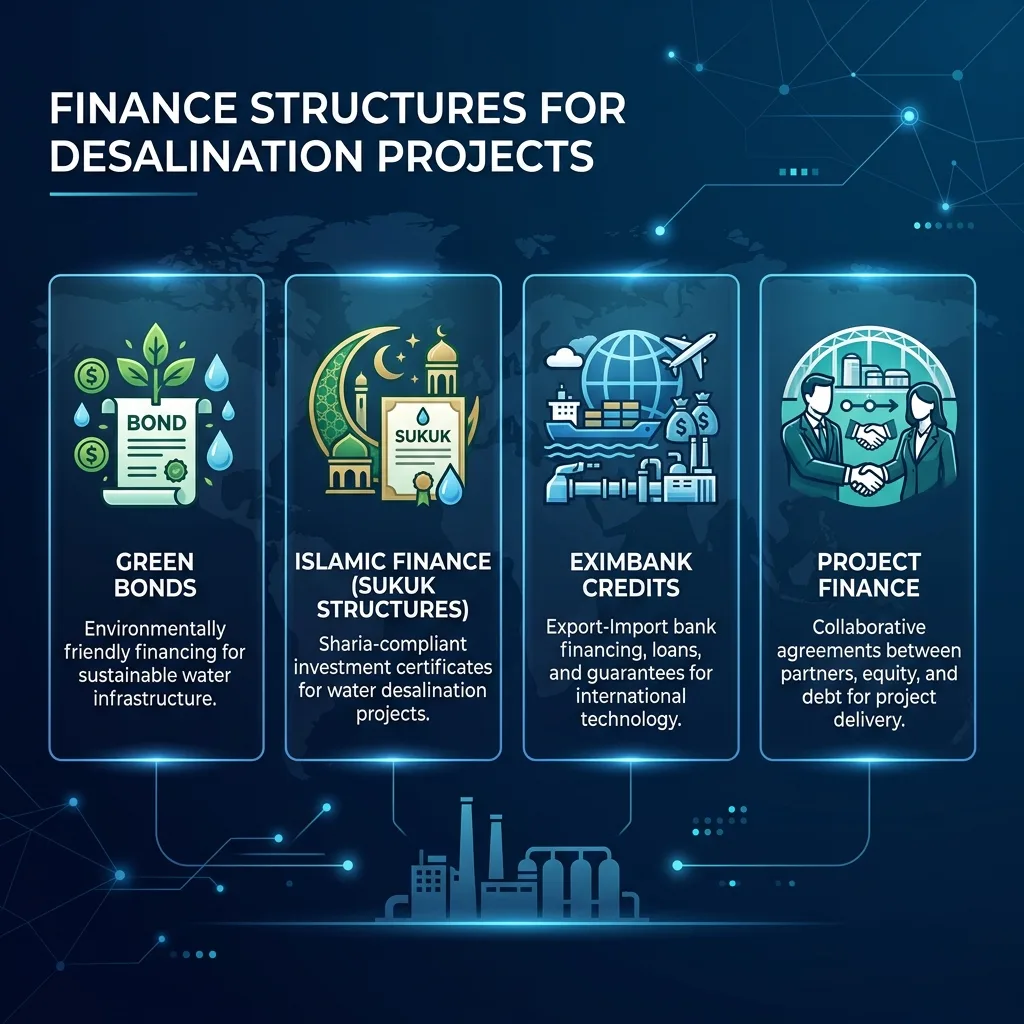
1. Islamic Finance (Sukuk, Murabaha, Ijarah)
Islamic finance models are frequently preferred over traditional bank loans in the MENA region due to interest sensitivities. How does the Sukuk structure work for desalination plant installation under Islamic finance? Sukuk is a lease certificate based on an asset (here, the desalination plant). The investor purchases the certificate, partners in the plant, and shares in the lease revenues. At the end of the period, the plant is transferred to the operator. Financial institutions providing this funding include the Islamic Development Bank (IsDB) and Dubai Islamic Bank.
2. Green Bonds
The conditions for financing water treatment projects through green bonds, which have grown rapidly in recent years, are determined by the environmental impacts of the project. For desalination plants to qualify for green bonds, criteria such as mandatory energy recovery (ERD), brine management standards, and renewable energy integration (such as solar power) are required. Key financiers include the World Bank (IFC) and EBRD.
3. Eximbank Credits
State agencies supporting export activities provide suitable credits to projects purchasing equipment and engineering services from their countries. Eximbank desalination credit interest levels and repayment plans vary depending on equipment sourcing rates and the share of country-origin engineering. At DipBlue, through agreements with Türk Eximbank, we provide foreign projects with suitable long-term financing solutions.
| Eximbank | Interest Level | Tenor | Financing Condition |
|---|---|---|---|
| US Eximbank | Competitive | 10-18 yıl | Minimum 50% US equipment |
| China Eximbank | Very Low | 15-20 yıl | Minimum 70% Chinese equipment |
| Korea Eximbank (KEXIM) | Low | 12-15 yıl | Korean engineering and equipment |
| Turkey Eximbank (Türk Eximbank) | Competitive | 7-10 yıl | Turkish equipment and engineering |
4. Project Finance and Investor Criteria
This is the classic model used in large PPP and BOOT projects. The 5 criteria investors look for in an SWRO project feasibility report are: offtake agreements, technology reliability (proven membranes and ERD), energy cost stability, environmental permits (brine discharge approvals), and sponsor strength. A project meeting these criteria can be funded with a high debt-to-equity ratio.
5. Case Study: Financing Structure in a Large-Scale Project
In a typical desalination project, total investment can be planned as 30% equity and 70% debt. In debt sourcing, using multiple sources is preferred to distribute risk and cost. For example, a significant portion of the debt is financed through Islamic Sukuk, while the remaining part is supported by green bonds and equipment-linked Eximbank credits, lowering the average cost of capital.
Conclusion: Structured Financing is Security
Financial modeling is the survival guarantee for desalination projects. A properly structured portfolio secures long-term cash flow.